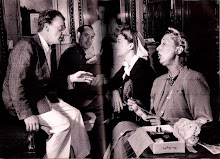
I just recently watched the 1937 James Cagney film Something to Sing About, and I didn't really like it. James Cagney was good as Terry Rooney, the New York bandleader who goes to Hollywood and becomes an overnight sensation, but takes off for the South Seas with his new bride after completing his first film, convinced he's a flop. I had a couple of nitpickings about this films, such as it was too sweet for my taste--sweeter than a Shirley Temple movie. I much prefer the comically cynical Footlight Parade to this movie. Furthermore, in his performance, Cagney sometimes acts like one of those annoying adults. Yet, despite my many nitpickings, there are a few scenes I kinda liked, such as the scene where Cagney dances with two guys on the ship during his honeymoon and the ending scene where Jimmy Cagney comes back to the nightclub where his band plays.
 By 1936, James Cagney was one of the top ten moneymaking stars in Hollywood. He was also one of Warner Bros.' most versatile stars, equally effective in musicals, gangster films, and comedies. But he was unhappy with the studio's recent choice of material, and its demand that he make five films a year instead of the four his contract stipulated. So he took them to court, won, and walked out, shocking Hollywood by signing with Grand National, a newly formed independent company. His first Grand National film, Great Guy (1936) was well received. His second was Something to Sing About (1937), Cagney's first musical since Footlight Parade (1933).
Playing opposite Cagney was Evelyn Daw, a 20-year-old newcomer from South Dakota with a terrific soprano voice. Daw made only one more film before disappearing from the screen, although she continued to work in theater and opera. Standouts in the supporting cast are William Frawley (the future Fred Mertz for those of you who are I Love Lucy fans) as a publicist, and Gene Lockhart playing the studio boss, a conniving blowhard who cons Cagney's character into an unfair contract. Some Hollywood insiders noted the resemblance to Jack Warner. Sure I did enjoy the many satirizations of Hollywood but they weren't satirical enough to fit my tastes.

Critics were glad to see Cagney back in tap shoes, and playing a romantic lead for a change. Otis Ferguson of the New Republic gave Something to Sing About points for effort, saying "much can be done by good people who break away and bring the industry up short by independent accomplishment." But in spite of all the freshness and energy that Cagney and his colleagues brought to the film, they couldn't overcome the fact that the budget for Something to Sing About was skimpy (it was all the fledgling studio could afford), the music wasn't memorable, and the film didn't receive wide distribution. This film was no Singin' in the Rain or Anchors Aweigh since it didn't have any memorable scenes as well. (I always get Anchors Aweigh and On the Town mixed up: is the scene where Gene Kelly dances with the cartoon mouse in AA or OTT?) In an era of studio domination, an independent didn't have a chance (a proven point of the phrase "There's just no room for the little guy").

If Something to Sing About can be said to have any interest at all, other than as a curiosity in a great star's career, it is for the conscious analogies it permits one to draw between Terry Rooney's fictional movie career and Cagney's genuine one. Cagney walked out on Warner Bros. many times, like his character in this film did once, but he always came back and signed a new contract, just like his character in this film signs a seven-year contract (which also says that he has to be a bachelor in case his many female fans wanna sleep with him [sorry if that was a little off-color but it was implied] but that really has no connection with Cagney's film career). And if any of you have seen this movie, you'll know that Terry Rooney's real name is Thaddeus MacGillicudy and if ur also an I Love Lucy fan, u'll know that Lucy Ricardo's maiden name is MacGillicudy. So u can see that this movie has some connections with I Love Lucy, with the future Fred Mertz and the name MacGillicudy.

This movie also offers a glimpse of some of Cagney's comedic ability that we never really got to see. According to the book "Cagney" by John McCabe:
One of Cagney's key characteristics as a performer is too briefly and
tantalizingly touched on in Something to Sing About: his essential status as a
comedic actor. There is no performance in the first two thirds of his career
that is marked by comedy, even if sardonic and bitter. In the present film, as
he and his wife are walking down the street, he is explaining film comedy and
brilliantly illustrates five of its staples: a double take, a triple take, and a
triple take with a slow burn and one-eyed fadeaway, this last done in the style
of its great master, Jimmy Finlayson, Laurel and Hardy's prime stooge. Cagney
then caps these with veteran Keystone comic Charlie Murray's famous
mouth-ends-down grimace, which causes a lady passing by to scream in fright.
With regrettable brevity we glimpse Cagney the Clown, of whom, alas, we see
little in his career.
I would recommend this film to any James Cagney who likes seeing him in musicals. Happy commenting!! And have a wonderful holiday season!!


(Next blog: Great Guy [1936] )
) 
 )
) 

Clips from Something to Sing About:


 Although he now seems the only logical choice, Cagney would have missed out on his big chance if a deal between Cohan and MGM to make a film to be called The Four Cohans hadn't fizzled out. Covering the years when Cohan had toured with his father, mother and sister, the movie would have starred Mickey Rooney as the young Cohan. The deal collapsed after studio head Louis B. Mayer refused to allow Cohan the right to final cut on the proposed film. The next movie mogul to show an interest in the project was Samuel Goldwyn, who had a commitment to make a film starring Fred Astaire. When Astaire refused the role of Cohan as not right for him, the rights were picked up by Warner Bros., who cast resident star Cagney in the role with


 Walter Huston was especially great in this film; he would later be in the Humphrey Bogart film Treasure of the Sierra Madre (1948), which was directed by his son, John Huston. (Little trivia question: Who is Walter Huston's granddaughter?) He earlier appeared in an uncredited role in another Bogart film The Maltese Falcon (1941), which was also directed by his son.


 I found it kind of curious that Cagney was starring that takes place around the time during which he was born (he was born in 1899). What I also noticed about him in this film is that his voice is more high-pitched than normal and that he uses his body more (or maybe the speed of the film was faster than normal).
 .jpg)


 I'm very sorry if this film review isn't as good as the other film reviews, but I don't know enough about this film, except that the screenplay was written by the Epstein brothers, the same guys who wrote the screenplay for Casablanca. As for the recommendations, I would recommend it for James Cagney fans who love to see the guy in romantic comedies and other versatile roles (as well as being a romantic comedy, this film is also a drama). Once again, comments & opinions on this fil


 ides on the side (the water was pumped by technicians during shooting) and was lined with glass on the sides and floor. Still, I see no reason watching the sequence whenever I watch the film because for one thing, there is no James Cagney, and for another thing, it's too long. I would recommend this movie for any James Cagney fan, es