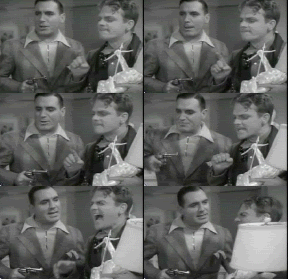
+dances+with+a+young+lady+in+a+scene+from+an+unknown+film.jpg) I have just recently watched the 1934 James Cagney movie Here Comes the Navy for the first time, and it was cool!! James Cagney was good as Chesty O'Connor, a cocky, can-do civilian riveter-turned-sailor (this was before the Navy became a symbol of homosexual camp) who represents the common working man of the Depression. I'm so glad I finally got to watch this movie that I so desperately wanted to see! Even though it was very different from the trailer, I must say that I pretty much liked it!! Anyway, James Cagney is with his two best buddies--Pat O'Brien and Frank McHugh--in this film! Frank McHugh's role was big compared to his other roles in Cagney films, and he seemed to have a lot of lines as well as the most comedic dialogues w/ Jimmy Cagney. As for Pat O'Brien, well his and Jimmy's chemistry is very apparent even though their characters don't get along in the film. Their bromance is amazing; I have often compared them to Robert Downey, Jr. and Jude Law, who were just as good together in Sherlock Holmes!!! And Gloria Stuart, who is almost a centigenarian now, was also good as Cagney's love interest. Anyhow, I felt very sorry for Jimmy Cagney's character earlier in the movie when he is beaten mercilessly by Pat O'Brien in a fight. And his girlfriend didn't even help him, which really sucked. (And I must add that this movie, with its nautical theme, had me longing for the beach.
I have just recently watched the 1934 James Cagney movie Here Comes the Navy for the first time, and it was cool!! James Cagney was good as Chesty O'Connor, a cocky, can-do civilian riveter-turned-sailor (this was before the Navy became a symbol of homosexual camp) who represents the common working man of the Depression. I'm so glad I finally got to watch this movie that I so desperately wanted to see! Even though it was very different from the trailer, I must say that I pretty much liked it!! Anyway, James Cagney is with his two best buddies--Pat O'Brien and Frank McHugh--in this film! Frank McHugh's role was big compared to his other roles in Cagney films, and he seemed to have a lot of lines as well as the most comedic dialogues w/ Jimmy Cagney. As for Pat O'Brien, well his and Jimmy's chemistry is very apparent even though their characters don't get along in the film. Their bromance is amazing; I have often compared them to Robert Downey, Jr. and Jude Law, who were just as good together in Sherlock Holmes!!! And Gloria Stuart, who is almost a centigenarian now, was also good as Cagney's love interest. Anyhow, I felt very sorry for Jimmy Cagney's character earlier in the movie when he is beaten mercilessly by Pat O'Brien in a fight. And his girlfriend didn't even help him, which really sucked. (And I must add that this movie, with its nautical theme, had me longing for the beach.  )
) Modern-day military movies are more likely to focus on Marine special forces or Navy SEALs than on ordinary sailors, but until the Vietnam era the United States Navy had enough mystique to fuel many popular films. Here Comes the Navy, made between the world wars in 1934, is a good example. Drenched in navy atmosphere, it was filmed in real navy locations and populated with real navy extras polishing guns and swabbing decks in the background. Most impressive of all, much of the action was shot on the U.S.S. Arizona, which became legendary when Japanese aircraft sunk it in the December 1941 attack on Pearl Harbor that propelled the U.S. into World War II. All this makes the film a natural for navy buffs and a smooth-sailing history lesson for everyone else.
The picture has good Hollywood credentials, too. Its stars are James Cagney and Pat O’Brien, making the first of their nine movies together – they did seven more for Warner Bros. and then reunited for Ragtime in 1981, the last feature for both of them. Here Comes the Navy also scored a nomination for the Best Picture Academy Award, which it lost – along with such other contenders as The Thin Man and The Gay Divorcee – to It Happened One Night, a hard movie to beat (speaking of which, I hope Avatar isn't that way @ the Oscars this year
 ).
).While working in the shipyard, Cagney runs afoul of Biff Martin, chief petty officer of the Arizona, played by O’Brien with just a smidgen less feistiness than Cagney displays. Their squabble turns into a brawl when they compete for a woman at a dance, and when Chesty loses the fight – the lovely lady distracts him just as Biff throws his best punch – the scrappy laborer sets his sights on revenge. This is easier said than done, since Biff immediately goes to sea, so Chesty does what any self-respecting movie character would do: He joins the navy, volunteers for the Arizona, and loo
 ks forward to decking his enemy.
Eventually the two meet again, but when Chesty prepares to give Biff what’s coming to him, Biff informs him of something he should have learned in basic training: Officers rank higher than enlisted men, and if Chesty’s fists fly, the rest of his body will land in the brig. Complicating things further, Chesty sees another alluring woman and falls so much in love that he can’t give her up – even when she turns out to be Dorothy “Dot” Martin, his enemy’s loving sister. This sends all of them into a three-way feud, with Dorothy snagged between her sailor friend’s wooing and her big brother’s sco
 lding.
Could things be any worse? You bet. Chesty sneaks off the ship to see Dorothy, and gets caught when he tries to sneak back on. Angry at being punished, he belligerently bad-mouths the navy, which shocks his shipboard buddies and turns them against him. Deciding he’s beaten all around, Chesty slinks away and transfers from battleship duty to a dirigible unit. There he shows he’s a trusty American after all, and everyone has a happy Hollywood ending.
In addition to the U.S.S. Arizona, parts of Here Comes the Navy were shot on location at real navy yards. The picture also shows maneuvers by the Pacific Fleet, and the climax -- when Chesty performs a daring rescue involving a dirigible trying to land at sea -- uses footage of the U.S.S. Macon, an American airship that was downed by a storm the following year, bringing an end to the military’s experiment with lighter-than-air vehicles. The film’s rescue scene is based on an actual incident two years earlier, when crewmen of the U.S.S. Akron held onto a blimp’s ground ropes as it lifted into the air; the real-life accident killed two men, but this didn’t stop Warner Bros. from transforming it into a chance for Chesty to save the day. Cagney did some of his own stunt work, burning his hands on a rope until they “looked like hamburger,” as he described it later.

Along with its glimpses of armed-forces history, Here Comes the Navy reflects an interesting moment in Hollywood history: It was Cagney’s first movie after the Catholic Legion of Decency gained censorship power in the industry, and Warner Bros. wanted to signal that the star’s brash personality wouldn’t be toned down as long as it kept selling tickets. That said, the movie struck some observers as unexpectedly subdued. In addition to laughs and authenticity, the reviewer for the New York Times praised it for having “the added advantage, in these parlous times, of being beyond censorial reproach.” This was especially “remarkable” in a Cagney production, the critic continued, since his “rough-and-tumble antics in several earlier pictures” had been “held up to scorn by those who would reform the screen.” While the star himself hadn’t changed his style, the reviewer wrote, “the restraining hand of the producer, writer, director (or all three), never is relinquished.”

The director who may or may not have restrained Cagney was Lloyd Bacon, whose most celebrated picture is 42nd Street, the popular Depression musical of 1933. That movie gains a lot of its pizzazz from the song-and-dance numbers staged by Busby Berkeley, and in Here Comes the Navy the military interludes serve a similar purpose, punching up a comedy-drama scenario that might easily run out of steam on its own.

The comedy episodes were enthusiastically received by the New York Times reviewer, who applauded some of “the heartiest laughs of the current cinema season” and called the finale, wherein a caterwauling old lady sings a wedding song from lyrics tattooed on her dopey son’s torso, a “perfect comedy climax.” Today’s viewers won’t be so tickled by such silliness, and it’s painful to watch the movie’s disgracefully racist material (it wasn't so painful for me to watch; trust me, I've seen worst), as when Chesty puts on blackface so he can slip off the ship among African-American sailors going on leave. Like the battleship and dirigible sequences, these are best viewed as historical artifacts from America’s not-so-distant past. Seen in this light, Here Comes the Navy has more to reveal than Cagney’s talent for high-spirited hijinks.
 Here Comes the Navy is the first and best of the Cagney-O'Brien service pictures and features excellent performances by the entire cast. Cagney plays his character with just the right blend of intensity and devilish, sarcastic, Bart Simpson-like charm. Anyway, this is my favorite Cagney film next to Footlight Parade, Taxi!, and Jimmy the Gent. My prospective favorite James Cagney films, which I have yet to see, are Hard to Handle and Devil Dogs of the Air. And since I mentioned earlier that it was a contender for the 1934 Best Picture Oscar, it isn't nearly half as famous as some of its rivals, like Gay Divorcee and Thin Man. But it's just as charming and lighthearted as the two, and just as watchable, compared to some of the other 1934 films like Cleopatra and Imitation of Life.
 Anyway, I would recommend the film for James Cagney fans who love seeing him in military dramas. Happy commenting!!!


(Next blog [for sure]: Animal C
 rackers [1930])


Clips from Here Comes the Navy (1934):


 Warner Brothers' inspirational tale The Fighting 69th (1940) was an enormous hit with the public when it first premiered in pre-Pearl Harbor America. The studio rightfully assumed that American audiences, well aware of the escalating signs of war in Europe and the Pacific, would respond well to a patriotic action-adventure. And the box office take alone convinced Warner Bros. mogul Jack Warner to continue making gung-ho war films, culminating in a movie about the much-decorated World War I hero, Sergeant York (1941). Like the latter film, The Fighting 69th is based on the true-life story of a World War I hero - Father Duffy, who was played by Pat O'Brien. The real Father Duffy was the regimental chaplain of "the fighting 69th," a group of Irish national guardsmen who were incorporated into the Rainbow Division in 1917 after distinguishing themselves in combat.


 James Cagney, Pat O'Brien, and George Brent (who I obviously underestimated by thinking he wasn't a very famous actor but he apparently is) are all billed above the title (that's because they're all better and more important than the f****** title [sorry, but I just had to say that]), and the impressive group of actors is featured in of Warners' most stunning visual "cast parades" before the action begins. William Keighley's depiction of the "Rainbow Division" opens at Camp Mills, New York, featuring fictionalized versions of real-life soldiers Father Duffy, "Wild Bill" Donovan (Brent), and Joyce Kilmer (Jeffrey Lynn), the poet best known for "Trees."

 (Next blog: The Bride C

.jpg)
 Boy Meets Girl (1938) is a perfect example of why Warners' contract actors and directors were called The Warner Bros. Stock Company. The film marked James Cagney's eighth time working with director Lloyd Bacon (they would make nine movies total). It was also