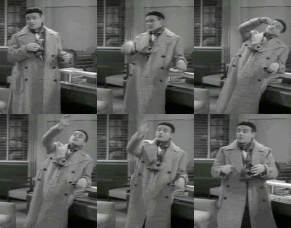
.jpg) I just recently watched the 1938 James Cagney movie Boy Meets Girl for the first time, and it was kinda weird. James Cagney was crazy as Robert Law, a lazy screenwriter brought to Hollywood from Vermont and is partners with Carlisle Benson (Pat O'Brien). Pat O'Brien was also pretty crazy, but James Cagney was more flamboyant and therefore caught my attention. Since the two real-life best friends are both down-to-earth actors, it's hard imagining them playing such wild and eccentric guys. And the pregnant commissary waitress really does fit the dumb blonde stereotype. Another thing in this movie that caught my attention was that future US President Ronald Reagan (who was an actor in his pre-President days) played the announcer at the fictional movie premiere. The main thing I liked about this movie was how it went behind the scenes of movies, and being a film student, I like learning how films are made. Cagney also dances a little in this film but in a very cocky way.
I just recently watched the 1938 James Cagney movie Boy Meets Girl for the first time, and it was kinda weird. James Cagney was crazy as Robert Law, a lazy screenwriter brought to Hollywood from Vermont and is partners with Carlisle Benson (Pat O'Brien). Pat O'Brien was also pretty crazy, but James Cagney was more flamboyant and therefore caught my attention. Since the two real-life best friends are both down-to-earth actors, it's hard imagining them playing such wild and eccentric guys. And the pregnant commissary waitress really does fit the dumb blonde stereotype. Another thing in this movie that caught my attention was that future US President Ronald Reagan (who was an actor in his pre-President days) played the announcer at the fictional movie premiere. The main thing I liked about this movie was how it went behind the scenes of movies, and being a film student, I like learning how films are made. Cagney also dances a little in this film but in a very cocky way. Boy Meets Girl (1938) is a perfect example of why Warners' contract actors and directors were called The Warner Bros. Stock Company. The film marked James Cagney's eighth time working with director Lloyd Bacon (they would make nine movies total). It was also Pat O'Brien's eighth picture (out of ten) with Bacon. And for pals Cagney and O'Brien, Boy Meets Girl made for a fifth film collaboration the two would make nine movies together, including both stars' last feature Ragtime (1981). Also joining the group was Ralph Bellamy on his second film with both Cagney and Bacon. Because of their close working relationship, it's no wonder that Cagney, O'Brien and Bellamy became friends off-camera as well and eventually the three actors formed a social clique that also included Boy Meets Girl co-star Frank McHugh as well as Spencer Tracy and Frank Morgan; they met for dinner every Thursday and called themselves "The Boys Club."
As well as Ronald Reagan, several Warner newcomers are also showcased in Boy Meets Girl. Penny Singleton, who made a few films for Warners before moving to Columbia to star in the Blondie series, plays the manicurist (she was later the voice for Jane Jetson in the animated series, The Jetsons). And Carole Landis turns up as the commissary cashier. There's also Marie Wilson, who got her start in the Laurel and Hardy vehicle Babes in Toyland (1934), as Susie.
The role of Susie was originally intended for Marion Davies. There are several accounts as to why Davies, the longtime mistress of newspaper magnate William Randolph Hearst, did not appear in the film. Some say Hearst objected to Davies playing Susie a pregnant (and  husbandless) waitress. Others cite the timing of Hearst pulling his financially strapped Cosmopolitan Pictures off the Warners lot. While other accounts claim Davies was displeased with casting changes (the comedy team of Olsen & Johnson were originally to have played the screenwriting team portrayed by the less comedic Cagney and O'Brien) and by the size of her role. The part of Susie was reduced even further after Davies was replaced by Marie Wilson. Regardless of the reason, Davies never made another film. Ever Since Eve (1937) would stand as her Hollywood swansong.
 husbandless) waitress. Others cite the timing of Hearst pulling his financially strapped Cosmopolitan Pictures off the Warners lot. While other accounts claim Davies was displeased with casting changes (the comedy team of Olsen & Johnson were originally to have played the screenwriting team portrayed by the less comedic Cagney and O'Brien) and by the size of her role. The part of Susie was reduced even further after Davies was replaced by Marie Wilson. Regardless of the reason, Davies never made another film. Ever Since Eve (1937) would stand as her Hollywood swansong.
Boy Meets Girl was based on the hit Broadway play by Sam and Bella Spewack. The characters played by Cagney and O'Brien on film were supposedly based on real life screenwriters Ben Hecht and Charles MacArthur. And it's been suggested Bellamy's part as Studio Supervisor was based on Fox's Darryl Zanuck. Sam and Bella Spewack would go on to great success penning the screenplay for My Favorite Wife (1940) and the book for the musical Kiss Me Kate (for which they would also win the Tony Award), but the film version of Boy Meets Girl failed to live up to its stage popularity.
Cagney for one thought the film's pacing was too fast (and so did I). After screening rushes one day, he reportedly said to Bellamy, "would you tell me what I just said? I couldn't understan d a word." (He was speaking what I thought while watching this movie.) It was evidently a moment in his career that Cagney never forgot. Cagney also brought up Boy Meets Girl twenty-three years later when tackling another comedy, One, Two, Three (1961). This time, director Billy Wilder put Cagney's fears to rest, assuring him the pacing wouldn't be too fast at the expense of dialogue. Funnily enough, Cagney apparently never saw Boy Meets Girl until years later on TV and he found it much better than he remembered.

Boy Meets Girl made good use of Warners sound stages, back lots and front offices, so it's an interesting behind-the-scenes look at the studio. Also, for an inside joke, check out the marquee behind Ronald Reagan at the film premiere. The film's title is The White Rajah. This was the name of a script penned by Errol Flynn years earlier which was deemed too weak to film. Lloyd Bacon came across the script while looking for a title for Boy Meets Girl's fictional film premiere. Flynn was reportedly not amused.
 d a word." (He was speaking what I thought while watching this movie.) It was evidently a moment in his career that Cagney never forgot. Cagney also brought up Boy Meets Girl twenty-three years later when tackling another comedy, One, Two, Three (1961). This time, director Billy Wilder put Cagney's fears to rest, assuring him the pacing wouldn't be too fast at the expense of dialogue. Funnily enough, Cagney apparently never saw Boy Meets Girl until years later on TV and he found it much better than he remembered.
Boy Meets Girl made good use of Warners sound stages, back lots and front offices, so it's an interesting behind-the-scenes look at the studio. Also, for an inside joke, check out the marquee behind Ronald Reagan at the film premiere. The film's title is The White Rajah. This was the name of a script penned by Errol Flynn years earlier which was deemed too weak to film. Lloyd Bacon came across the script while looking for a title for Boy Meets Girl's fictional film premiere. Flynn was reportedly not amused.
The first three-quarters of the film was like a painfully unfunny Simpsons episode, but the last quarter of the film got very exciting, like a very good ABC drama show, when the comedy and slapstick shenanigans calmed down. Indeed, the problem with Boy Meets Girl is the out-of-control, rapid-fire dialogue, much of which is untelligible (we all know that Cagney talked fast but this was just ridiculous). And some of the lines that are discernible are delivered in such an obnoxious manner (by both Cagney and O'Brien) that they are painful to the ear (I' ll say)! The film is approximately one-quarter charm and three-quarters torture (no wonder I was so reluctant to watch it). Most of it resembles a Poverty Row production, rather than an A film released by a major studio (and it seemed pretty low for Warner Brothers plus it was more like a Marx Brothers film).
 ll say)! The film is approximately one-quarter charm and three-quarters torture (no wonder I was so reluctant to watch it). Most of it resembles a Poverty Row production, rather than an A film released by a major studio (and it seemed pretty low for Warner Brothers plus it was more like a Marx Brothers film).
 Following this embarrassing effort, Cagney and O'Brien would collaborate on their greatest Warner Bros. film as a team, Angels with Dirty Faces (which I'm pretty much sick of by now, no offense). This farce was something new for Cagney. According to the book "James Cagney: A Celebration" by Richard Schickel:
For Cagney, Boy Meets Girl represents a complete novelty. He had never before
played in a pure farce, but in this form he was as expert as he ever was on the
screen. The speech and precision of his speech pattern, the inventive no-waste
choreography of his movements are superbly calculated. And he makes a masterful
lead dancer for O'Brien, setting the tone and place for their intricate and
dizzying verbal exchanges--and their pratfalls--with his pal following with
perfect professionalism and adding a few neat improvisations of his own. But it
is the suggestion of cold reasonableness that Cagney brings to his performance
that is a revelation. In is way Robert Law--wonderfully ironic name--is as much
an anarchist as Tom Powers ever was. Perhaps so, since as a literate man he
would be familiar with that word, understan its meaning and its application to
his behavior. He may be, then, even less moral that the instinct-driven
gangster. Cagney conveys that self-conciousness, that air of the put-on--which
is not entirely dissimilar to what Groucho Marx used to imply in his
work--without ever choking off any of his laughs. [I love how he smiles, in a
happy, mischievous sort of way.]
I would & wouldn't recommend this farce for any James Cagney fan, but if any Cagney fan would love to see their idol in all of his movies, then this is the film for them. After all, it is a far cry from his normal roles, which is what I like about it. Personally, this was one of Cagney's 1930s films that I wasn't so crazy about seeing, but since I'm so interested in seeing all of his '30s movies (and seeing the cute, baby face he had during this period), I saw this movie anyway, just like I intend to see The Frisco Kid, Winner Take All, etc. (And keep your shirts on: I will see White Heat.) Happy Commenting!!!
(Next blog [for sure]: The Fighting 69th [1940])
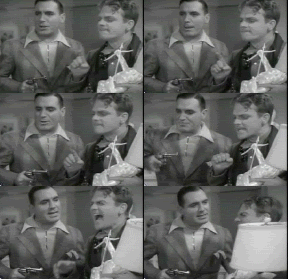


Clips from Boy Meets Girl:


 favor for his friend? I don't know; that is the question.


_07.jpg)

_01.jpg)




Vintage+original.jpg)